Mga Pahina

"This post confirms my ownership of the site and that this site adheres to Google AdSense program policies and Terms and Conditions: ca-pub-4735876206293998"

Linggo, Mayo 8, 2011

easter island statues


Easter Island has long been the subject of curiosity and speculation. How and why did its inhabitants carve and transport the massive statues which surround the island? What remains of this culture today, and what lessons can we learn from their legacy?  This page is a resource for information on the Internet about Easter Island, also known as "Rapa Nui" and "Isla de Pascua".
Easter Island is over 2,000 miles from the nearest population center, (Tahiti and Chile), making it one of the most isolated places on Earth. A triangle of volcanic rock in the  South Pacific - it is best known for the giant stone monoliths, known as Moai, that dot the coastline. The early settlers called the island "Te Pito O Te Henua" (Navel of The World). Admiral Roggeveen, who came upon the island on Easter Day in 1722, named it Easter Island. Today, the land, people and language are all referred to locally as Rapa Nui.
There has been much controversy and confusion concerning the origins of the Easter Islanders. Thor Heyerdahl proposed that the people who built the statues were of Peruvian descent, due to a similarity between Rapa Nui and Incan stonework. Some have suggested that Easter Island is the remnant of a lost continent, or the result of an extra-terrestrial influence . Archaeological evidence, however, indicates discovery of the island by Polynesians at about400 AD - led, according to legend, by Hotu Matua. Upon their arrival, an impressive and enigmatic culture began to develop. In addition to the statues, the islanders possessed the Rongorongo script; the only written language in Oceania. The island is also home to many petroglyphs (rock carvings), as well as traditional wood carvingstapa (barkcloth) crafts, tattooingstring figures, dance and  music.  

Huwebes, Mayo 5, 2011

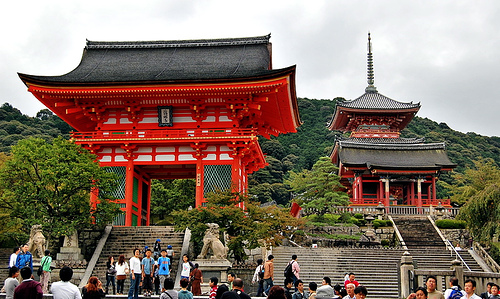
Kiyomizu Temple Japan


Much more popular Kiyomizu Temple (Kiyomizu dera, in Japanese) is, for most of the visitors to Kyoto should do. The main hall, is constructed out of columns. Effect, will extend from the foot of the mountain is the one who was a deck.
C.E. Kiyomizu Derain, was created from several Buddhist temples and the Kiyomizu temple originally dates from the eighth century, must see.
Temple, was founded in 798 CE, and (“Kiyo mizu” means pure water) is called for where a waterfall, which is portrayed on the right.
Deran Kiyomzu best-known view, the main hall is a large patio. He makes wooden ledge on the column, and is an impressive place.
After taking in the view from the porch of the city of Kyoto – down the left – most of the tourist, walking down the waterfall below. Water, are said to have the goods to improve.
In addition to the porch and health, for to horled, Kiyomizu Dera Temple, hoping for luck in love which will bring in visitors. Jishu Jinja sub-temples, located roughly 20 meters separate the two pieces make love. If you could manage to walk together with stones, eyes, closed, you’ll find love – or like the loyal followers, I believe. (Cheating, are still allowed: Pilgrims often they are seen to be taken by the other major.)
In addition to being a world heritage site, Kiyomizu recently as a candidate for a new seven wonders of the world as was delivered.
After a visit to the temple, Sannenzaka’nın come around, resulting in a small shopping street with traditional shops and a wooden house painted. You, that it was not his way past any Michi’nin Nene’s follow this path as you can wind down, Gion’a Kodaiji – the city and enjoy the traditional geisha quarters. Is the way Gojonoto Yasaka, a five-story pagoda.

stone henge England


Stonehenge is a prehistoric, mysterious circle of upright stones in southern England. Construction on the great monument began 5,000 years ago; the famous stones that still stand today were put in place about 4,000 years ago.
The great age, massive scale and mysterious purpose of Stonehenge draw over 800,000 visitors per year, and several thousand gather on the summer solstice to watch the sunrise at this ancient and mystical site.
The stones are aligned almost perfectly with the sunrise on the summer solstice, and it is almost unquestioned that Stonehenge was built as a spectacular place of worship.
Although the faith of the Stonehenge builders predates any known religion, the site has become a place of pilgrimage and worship for Neopagans who identify themselves with the Druids or other forms of Celtic paganism. It is also popular with New Age devotees, who report powerful energies at the site.

History

The current site, awe-inspiring as it is, is only part of the original Stonehenge. The original construction has suffered a great deal from both weather damage and human pillage of its rock over the millenia.
Stonehenge has been the subject of much archaeological and scientific inquiry and research, especially in the last century. The modern account of the construction of Stonehenge is based primarily on excavations done since 1919 and especially since 1950.
Archaeologists believe the construction of the site was carried out in three main stages, which have been labeled Stonehenge I, Stonehenge II and Stonehenge III.

Stonehenge I

The native Neolithic people of England began construction of Stonehenge I by digging a circular ditch using deer antlers as picks. The circle is 320 feet in diameter, and the ditch itself was 20 feet wide and 7 feet deep.
Next, they used the chalky rubble taken from the ditch to built a steep bank circle just inside the outer circle. Inside the bank circle, they dug 56 shallow holes known as the Aubrey holes (named after their discoverer, 17th century scholar John Aubrey).
Finally, two parallel stones were erected at the entrance to the circle, one of which, the Slaughter Stone, still survives. Also surviving are two Station Stones, positioned across from each other on opposite sides of the circle, which may also have been erected during this time. Stonehenge I seems to have been used for about 500 years and then abandoned.

Stonehenge II

Construction of Stonehenge II began around 2100 BC. In this phase, a semicircle of granite stones known as bluestones (from their original coloring) was assembled within the original bank and ditch circles. Several aspects of this phase are intriguing.
First, the bluestones come from the Preseli Mountains in South Wales, nearly 250 miles away. There were about 80 of them, weighing up to 4 tons each. How they were transported is not known, although scholars don't regard the feat as impossible and various theories have been presented.
It is intriguing to wonder, however, what makes the Stonehenge site so special that so much effort would be expended to drag the giant stones 250 miles instead of constructing the monument near the quarry.
Second, the entranceway to the semicircle of bluestones is aligned with the midsummer sunrise. The alignment was continued by the clearing of a new approach to the site, "The Avenue," which has ditches and banks on either side like the original outer circle. Two Heel Stones (so-named from the shape of the one that remains) were placed on the Avenue a short distance from the circle (and, today, very close to Highway A344).

Stonehenge III

Stonehenge III is the stone circle that is still visible today. During this phase, which was started in about 2000 BC, the builders constructed a circle of upright sarsen stones, each pair of which was topped with a stone lintel (horizontal capstone). The lintels are curved to create a complete circle on top.
There were originally 30 upright stones; 17 of these still stand. These stones came from the Marlborough Downs, 20 miles to the north, are 7 feet tall and weigh 50 tons each. The outside surfaces of all these stones were pounded smooth with hammers, and dovetail joints fasten the lintels to their uprights.
Within this stone ring was erected a horseshoe formation of the same construction, using 10 upright stones. Here the trilithons (set of two uprights plus the lintel) stand separated from one another, in 5 pairs. Eight of the original ten stones remain. The horseshoe shape opens directly towards the Slaughter Stone and down the Avenue, aligned with the summer solstice sunrise.
About a century later, about 20 bluestones gathered from Stonehenge II were placed in a horseshoe shape inside the sarsen horseshoe. Less than half of these remain. Some shuffling around of the bluestones and digging of holes (probably in preparation for placing the bluestones, which was not completed) occurred around 1500 BC. The Altar Stone is the biggest of these newly-arranged bluestones that remains. Around 1100 BC, the Avenue was extended all the way to the River Avon (over 9,000 feet from Stonehenge), indicating that the site was still in use at that time.

Martes, Mayo 3, 2011

Hagia Sophia, Istanbul


he Church of the Holy Wisdom, known as Hagia Sophia (Άγια Σοφία) in Greek,Sancta Sophia in Latin, and Ayasofya or Aya Sofya in Turkish, is a former Byzantine church and former Ottoman mosque in Istanbul. Now a museum, Hagia Sophia is universally acknowledged as one of the great buildings of the world.

History

Unfortunately nothing remains of the original Hagia Sophia, which was built on this site in the fourth century by Constantine the Great. Constantine was the first Christian emperor and the founder of the city of Constantinople, which he called "the New Rome." The Hagia Sophia was one of several great churches he built in important cities throughout his empire.
Following the destruction of Constantine's church, a second was built by his son Constantius and the emperor Theodosius the Great. This second church was burned down during the Nika riots of 532, though fragments of it have been excavated and can be seen today.
Mosaic portrait of Emperor 
Justinian from Ravenna.
Hagia Sophia was rebuilt in her present form between 532 and 537 under the personal supervision of Emperor Justinian I.
It is one of the greatest surviving examples of Byzantine architecture, rich with mosaics and marble pillars and coverings. After completion, Justinian is said to have exclaimed, Νενίκηκά σε Σολομών ("Solomon, I have outdone thee!").
The architects of the church were Isidore of Miletus and Anthemius of Tralles, who were professors of geometry at the University of Constantinople. Their work was a technical triumph, even though the structure was severely damaged several times byearthquakes. The original dome collapsed after an earthquake in 558 and its replacement fell in 563. Steps were taken to better secure the dome, but there were additional partial collapses in 989 and 1346.
Justinian's basilica was both the culminating architectural achievement of Late Antiquity and the first masterpiece of Byzantine architecture. Its influence, both architecturally and liturgically, was widespread and enduring in the Eastern Orthodox, Roman Catholic, and Muslim worlds alike.
For over 900 years the Hagia Sophia was the seat of the Orthodox Patriarch of Constantinople and a principal setting for church councils and imperial ceremonies.
In 1204 the cathedral was ruthlessly attacked, desecrated and plundered by theCrusaders, who also ousted the Patriarch of Constantinople and replaced him with a Latin bishop. This event cemented the division of the Greek Orthodox and Roman Catholic churches that had begun with the Great Schism of 1054. It also means that most of Hagia Sophia's riches can be seen today not in Istanbul, but in the treasury of St. Mark's Basilica in Venice.
Despite this violent setback, Hagia Sophia remained a functioning church until May 29, 1453, when Sultan Mehmet the Conqueror entered triumphantly into the city of Constantinople. He was amazed at the beauty of the Hagia Sophia and immediately converted it into his imperial mosque.
Hagia Sophia served as the principal mosque of Istanbul for almost 500 years. It became a model for many of the Ottoman mosques of Istanbul such as the Blue Mosque, the Suleiman Mosque, the Shehzade Mosque and the Rustem Pasha Mosque.
No major structural changes were made at first; the addition of a mihrab (prayer niche), minbar (pulpit) and a wooden minaret made a mosque out of the church. At some early point, all the faces depicted in the church's mosaics were covered in plaster due to the Islamic prohibition of figurative imagery. Various additions were made over the centuries by successive sultans.
Sultan Mehmed II built a madrasa (religious school) near the mosque and organized a waqf for its expenses. Extensive restorations were conducted byMimar Sinan during the rule of Selim II, including the original sultan's loge and another minaret. Mimar Sinan built the mausoleum of Selim II to the southeast of the mosque in 1577 and the mausoleums of Murad III and Mehmed III were built next to it in the 1600s. Mahmud I ordered a restoration of the mosque in 1739 and added an ablution fountain, Koranic school, soup kitchen and library, making the mosque the center of a social complex.
The most famous restoration of the Hagia Sophia was completed between 1847-49 by Abdülmecid II, who invited Swiss architects Gaspare and GuiseppeFossati to renovate the mosque. The brothers consolidated the dome and vaults, straightened columns,and revised the decoration of the exterior and the interior.
The discovery of the figural mosaics after the secularization of Hagia Sophia was guided by the descriptions of the Fossati brothers, who had uncovered them a century earlier for cleaning and recording. The Fossatis also added thecalligraphic roundels that remain today. They were commissioned to calligrapher Kazasker Izzet Efendi and replaced older panels hanging on the piers.
In 1934, under Turkish president Kemal Atatürk, Hagia Sofia was secularized and turned into the Ayasofya Museum. The prayer rugs were removed, revealing the marble beneath, but the mosaics remained largely plastered over and the building was allowed to decay for some time. Some of the calligraphic panels were moved to other mosques, but eight roundels were left and can still be seen today.
A 1993 UNESCO mission to Turkey noted falling plaster, dirty marble facings, broken windows, decorative paintings damaged by moisture, and ill-maintained lead roofing. Cleaning, roofing and restoration have since been undertaken; many recent visitors have found their view obstructed by a huge scaffolding stretching up into the dome in the center of the nave.

What to See

For a more visual description, see our interactive Hagia Sophia Floor Plan or browse our Hagia Sophia Photo Gallery. Click links in the text below for photos.
The Hagia Sophia has a classical basilica plan. The main ground plan of the building is a rectangle, 230 feet (70 m) in width and 246 feet (75 m) in length. The area is covered by a central dome (see outside and inside) with a diameter of 102 feet (31 m), which is just slightly smaller than that of the Pantheon in Rome.
The main dome is carried on pendentives: four concave triangular sections of masonry which solve the problem of setting the circular base of a dome on a rectangular base. Each pendentive is decorated with a seraphim. The weight of the dome passes through the pendentives to four massive piers at the corners, and between them the dome seems to float upon four great arches.
At the western and eastern ends, the arched openings are extended by semi-domes. The flat wall on each side of the interior (north and south) is called atympanum, and each one has 12 large windows in two rows, seven in the lower and five in the upper.
Just outside the entrance, stone cannonballs line the gravel path of the outer courtyard. These are the actual cannonballs used by Mehmet the Conqueror in his victorious 1453 battle for the city.
All interior surfaces are sheathed with polychrome marble, green and white with purple porphyry, and gold mosaics. On the exterior, simple stuccoed walls reveal the clarity of massed vaults and domes.
The Islamic calligraphic roundels suspended from the main dome since the 19th century remain in place and make for a fascinating religious contrast with the uncovered Christian mosaics. The names painted on the eight wooden medallions are: Allah and Muhammad (flanking the apse); the first four Caliphs Abu Bakr, Umar, Uthman and Ali (at the four corners of the dome); and the two grandsons of Mohammed, Hasan and Husayn (in the nave).
The Byzantine mosaics are being gradually uncovered, but only those on the higher gallery levels, which can be accessed by stairways on the payment of a fee. This means that Muslims do not have to confront much Christian imagery in the main chamber of the building, which was a mosque for nearly 500 years and retains all the equipment of a mosque.
When the Hagia Sophia was used as a place of worship, both for Christians and then for Muslims, the focus of the building was the east end, directly across from the entrance. This is because Christian churches are traditionally oriented towards the east, and Muslims always pray facing Mecca, which is southeast of Istanbul (the "east" end of the Hagia Sophia actually faces southeast). Thus the bulk of interesting sights are clustered in this area of the Hagia Sophia's huge interior.
At ground level, most of the sights date from the Islamic period. A beautiful marble structure in the apse is the mihrab, a niche found in all mosques that indicates the direction of Mecca. The large freestanding stairway to the right of the mihrab is the minbar, or pulpit from which sermons were given. To the left of the mihrab is the grand sultan's loge, built by the Fossati brothers who restored the Hagia Sophia in the 1800s.
Looking up from this area, one sees a splendid apse mosaic depicting theVirgin and Child. On the right is a partly damaged Archangel Gabriel mosaic. Gabriel used to face an Archangel Michael mosaic on the other side of the apse, but this is now almost entirely gone.
The most famous of the Hagia Sophia's mosaics are on the upper floor, in thegalleries. The South Gallery, where the great mosaics are, was used for church councils. When the Hagia Sophia was a mosque, the galleries were the place where women sat during worship services. Today, the galleries provide visitors with a commanding view of the nave from all sides and a closeup view of some of the best Byzantine mosaics to be seen anywhere.
The best-known mosaic is called the Deësis Mosaic, and it is the first you come to as you enter the South Gallery through the Marble Door. It depicts a triumphant and kingly Christ (known as "Christ Pantrocrator"), flanked by the Virgin Mary and John the Baptist.
At the end of the South Gallery are two golden Byzantine mosaics. On the left isChrist with Emperor Constantine IX Monomachus and Empress Zoe; on the right is the Virgin and Child with Emperor John II Comnenus and Empress Irene.
The modern exit from the Hagia Sophia is through the Vestibule of the Warriors, so called because it is where the emperor's bodyguards waited while he worshipped. Up high and behind you as you walk out is a splendid mosaic of the Virgin with Constantine and Justinian: Constantine the Great presents to the Virgin a model of the city of Constantinople (Istanbul), which he founded, and Emperor Justinian presents the church of the Hagia Sophia, which he rebuilt. This mosaic dates probably from the 10th century.
There are several interesting things to see outside Hagia Sophia, including three mausoleums of sultans, the church's baptistery, and the excavated remains of Theodosius' Hagia Sophia.

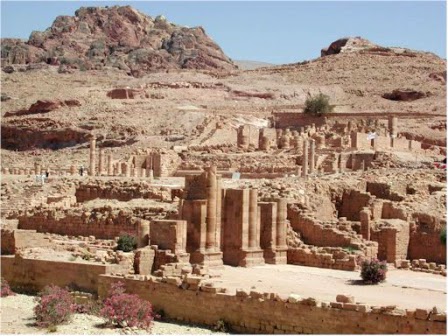
Petra, Jordan


Petra is the treasure of ancient world, hidden behind an almost impenetrable barrier of rugged mountains, boasting incomparable scenes that make it the most majestic and imposing ancient site still-standing nowadays.. It has been said "perhaps there is nothing in the world that resembles it", actually, for sure, there is nothing in the world that resembles it. The rock-carved rose-red city of Petra is full of mysterious charm, it was "designed to strike wonder into all who entered it"
Petra is considered the most famous and gorgeous site in Jordan located about 262 km south of Ammanand 133 km north of Aqaba. It is the legacy of the Nabataeans, an industrious Arab people who settled in southern Jordan more than 2000 years ago. Admired then for its refined culture, massive architecture and ingenious complex of dams and water channels, Petra is now a UNESCO world heritage site and one of The New 7 Wonders of the World that enchants visitors from all corners of the globe.
The approach through a kilometer long, cool, and gloom chasm (or Siq) a long narrow gorge whose steeply rising sides all but obliterate the sun, provides a dramatic contrast with the magic to come. Suddenly the gorge opens into a natural square dominated by Petra's most famous monument, The Treasury (El-Khazneh), whose intricately carved facade glows in the dazzling sun.
More facades beckon the visitor on until the ancient city gradually unfolds, one monument leading to the next for kilometer after kilometer. The sheer size of the city and the quality of beautifully carved facades is staggering and leads one to reflect on the creativity and industry of the Nabataeans who made Petra their capital.
Petra is always breathtaking, and never to be forgotten. It flourished for over 400 years around the time of Rome and Christ (pbuh), until it was occupied by the Roman legions of the Emperor Trajan in 106 AD.
The Petra basin boasts over 800 individual monuments, including buildings, tombs, baths, funerary halls, temples, arched gateways, and colonnaded streets, that were mostly carved from the kaleidoscopic sandstone by the technical and artistic genius of its inhabitants.
Petra sights are at their best in early morning and late afternoon, when the sun warms the multicolored stones, you can view the majesty of Petra as it was seen first when discovered in 1812 after being lost by the 16th century for almost 300 years!

Lunes, Mayo 2, 2011

Machu Picchu


The ancient city of Machu Picchu is  often referred to as the ‘lost city of the Incas’ situated on a mountain ridge some 8,000ft above sea level. Built around AD 1430 the site was abandoned by the Incas due to the Spanish conquest 100years later. In 1983 Machu Picchu also became a World Heritage Site.

Machu Picchu, one of the new 7 wonders and the royal retreat of the Incan emperos Pachacuti, sits atop the Urubamba Valley in Peru. Meaning “Old Mountain” in the Quenchua Indian language, the complex was constructed in the 15th century as a place for the emperor and his retinue to relax, hunt or entertain foreign dignitaries. The site also boasts Huayna Picchu Mountain, which looms nearly 1000 feet above terraces, plazas, and stone ruins as mists swirl up from the Urubamba river.

After the Spanish conquest in 1532, jungle growth enveloped the structures and temples. In 1911, Yale historian Hiram Bingham stumble upon the “lost city of the Incas.” Since then , its magnificent setting and detailed stonework have captivated countless visitors. There is never a wrong time to visit Machu Picchu: the symbol of community and dedication, but the ideal moment to experience the vista is during the rise of the Inca’s most powerful deity, the sun.

The best view is from the guardhouse, where visitors can anticipate the sun with nothing more than a llama grazing in the distance.”As the golden rays slip down Huayna Picchu, the buildings on the ridge below start to emerge from the shadows until Machu Picchu is presented in all its glory.

Chichen Itza


The list of new world wonders includes The Great Wall of China, Petra, Christ the Redeemer, Machu Picchu, The Colisseum, and Taj Mahal

The Mayan city of Chichen Itza, located in the Mexican state of Yucatan, was chosen as one of the "Seven New Wonders of the World" by approximately 100 million people around the globe, who cast their ballots by phone and Internet.

"The selection of Chichen Itza is recognition of the extremely vast and ancient historical and cultural heritage of Mexico, of which very few countries in the world can boast," said Francisco Lopez Mena, CEO of the Mexico Tourism Board.

The announcement of Chichen Itza's selection by the New7Wonders Foundation was made during a spectacular ceremony at Lisbon's Stadium of Light. 

The archaeological center of Chichen Itza, the most important Maya capital at the end of the classic period (750 to 1200 A.D.), was declared a UNESCO World Heritage Site in 1988.

Chichen Itza, which in the Mayan language means "at the mouth of the well of the Itza," was one of the most important Mayan political, commercial and religious centers of the classic period, but it fell into decline after the emergence of Mayapan as the new focal point of regional power in the Yucatan Peninsula.

The city is home to several buildings that are remarkable both for their architectural design and their religious and scientific significance. Among these are the Temple of Kukulkan (Feathered Serpent), the Observatory, the Temple of the Warriors and the Sacred Cenote (Well of Sacrifice).

The Temple of Kukulkan, one of the tallest and most notable structures in Mayan architecture sits on a 55.5-meter wide rectangular platform and rises to a height of 24 meters. Each of its four sides has 91 steps and the platform that crowns the pyramid is considered the 365th step, meaning there is one for each day of the solar calendar.

During the spring and fall equinox (March and September), visitors can enjoy a breathtaking spectacle: a corner of the Temple of Kukulkan casts a shadow in the shape of a giant "feathered serpent" that appears to slither its way down the side of the North staircase with the sun's movement. This natural phenomenon of light and shadow is a unique experience that attracts visitors from all parts of the world.

The Observatory, also known as "El Caracol" (The Snail) for its stone spiral interior staircase, is a cylindrical building with a dome that was used as an astronomical observatory, with its doors aligned to view the spring equinox, the declinations of the Moon and other astronomical events that helped determine the complex but extremely exact Mayan calendar.

Other popular sites at Chichen Itza are the Great Ballcourt - which, measuring 168 meters long and 70 meters wide, is the largest that has been discovered in the region known as Mesoamerica - and the Sacred Cenote, a large sinkhole 60 meters in diameter from which great treasures have been recovered: rings, necklaces and objects of gold and jade.

Thanks to all the people who voted, Chichen Itza today is a new wonder of the world, considered an icon of universal importance for humanity. As a result of this global and democratic selection process, the world will know Mexico for one of its 173 archaeological jewels, tangible evidence of the plurality and ethnic richness of the country's past.

We invite the world to visit and enjoy this impressive treasure, a symbol of the archaeological wealth of the Mayan world.

About the Mexico Tourism Board The Mexico Tourism Board (MTB) brings together the resources of federal and state governments, municipalities and private companies to promote Mexico's tourism attractions and destinations internationally. Created in 1999, the MTB is Mexico's tourism promotion agency, and its participants include members of both the private and public sectors. The MTB has offices throughout North America, Europe, Asia and Latin America.